
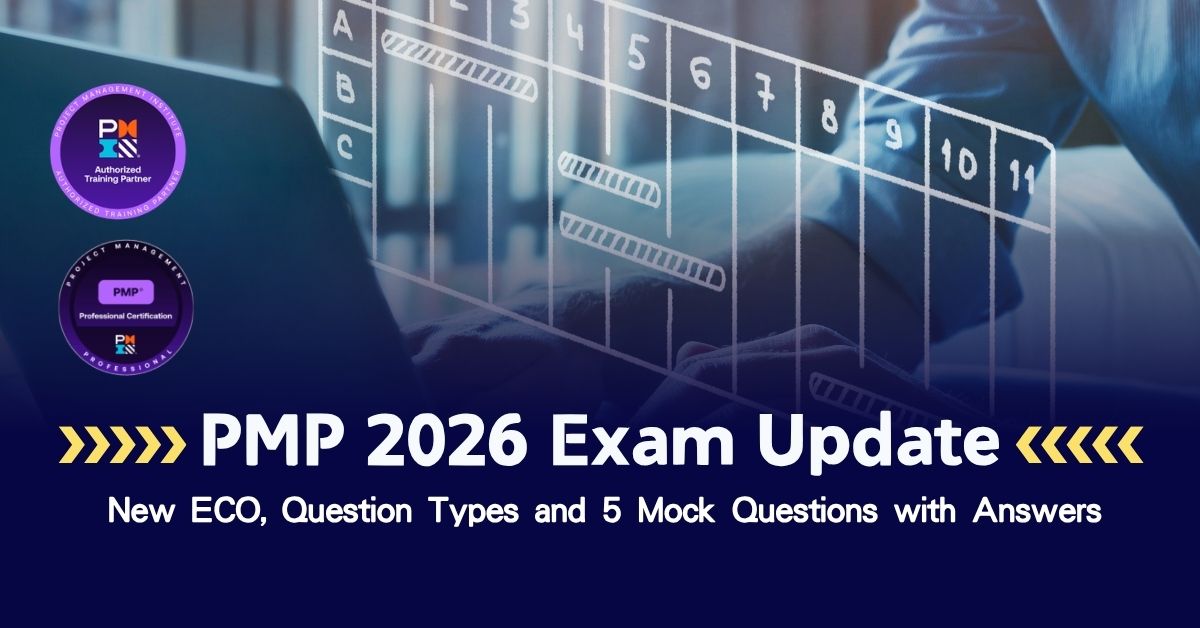
The updated Project Management Professional (PMP) exam officially launched on 9 July 2026. The new exam places more emphasis on situational judgement, with case/scenario questions and graphic-based items alongside familiar question formats. It also gives greater attention to AI, sustainability, value delivery and stakeholder engagement.
The exam remains 180 questions in 240 minutes, but the domain weightings have changed to People 33%, Process 41% and Business Environment 26%. If you are already studying, there is no need to throw away everything you have learned. A better approach is to map your existing PMP notes and question bank against the 2026 Exam Content Outline (ECO), then close any gaps.
This article first summarises the main 2026 exam changes, then works through five PMP mock questions to show how role, sequence and context affect the best answer.
1. PMP 2026 Exam Update: What Changed?
1.1 Business Environment Now Accounts for 26%
The 2026 ECO still uses the three domains – People, Process and Business Environment – but their weightings have been rebalanced. People has moved from 42% to 33%, Process from 50% to 41%, while Business Environment has increased from 8% to 26%.
This means Business Environment can no longer be treated as a minor topic. Governance, compliance, organisational change, business value and the external environment all deserve more study time.
| Domain | Previous weighting | 2026 weighting |
| People | 42% | 33% |
| Process | 50% | 41% |
| Business Environment | 8% | 26% |
1.2 Predictive, Agile and Hybrid Approaches All Matter
PMI states that approximately 40% of exam items represent predictive approaches, while the remaining 60% is divided between adaptive/agile and hybrid approaches. These ways of working can appear across all three domains, so the first step in a scenario is often to identify the project context before deciding what action makes sense.
1.3 More Emphasis on Situational Judgement
Multiple-choice questions remain part of the exam, but the updated exam uses a wider mix of formats. Case or scenario sets can present a fuller business or project situation before asking several related questions, while graphic-based items may require you to read a chart, diagram, image or other visual information before responding.
Knowing the terminology is therefore not enough. You also need to identify who owns the decision, what constraint matters and what problem should be addressed first.
1.4 AI, Sustainability and Value Delivery Are More Visible
AI, sustainability, value delivery and stakeholder engagement are more prominent in the 2026 exam. The practical challenge is not simply memorising extra terms, but understanding how they affect decision-making, risk, governance and business outcomes in predictive, agile and hybrid project settings.
1.5 Older Study Materials Can Still Be Useful
If you started preparing with older materials, you do not need to restart from zero. PMI notes that the core principles and approaches remain relevant. The more practical step is to use the 2026 ECO as a checklist, then update your PMP notes, practice tests and question bank for the new domain weightings, AI, sustainability, value delivery and the latest question formats.
2. 5 PMP Mock Questions with Answers: How to Read the Scenario
A common difficulty in PMP test questions is that more than one option can sound reasonable. The stronger answer usually depends on role, sequence and what the scenario is actually asking you to resolve.
The five questions below cover Agile, stakeholder engagement, Business Environment, change control and team performance.
2.1 Agile: The Sponsor Wants a New Requirement – Who Decides?
Mock Question 1 | Adaptive / Agile | Product Owner
| Question While taking over an agile project as a scrum master, you are being asked frequently by sponsor on whether new requirement can be added. What should you do next?:A. Review with project charter on scope coverage B. Understand maturity of the company in implementing agile project C. Refer to question to the Product Owner to decide D. Refer to project team to decide |
Answer: C. Refer to question to the Product Owner to decide
In an Agile / Scrum environment, the Product Owner is accountable for the Product Backlog, including decisions around value and priority. The Scrum Master helps the team understand and apply Scrum; the role does not replace the Product Owner in deciding product requirements. A sponsor may raise a need, but the Product Owner should assess whether it enters the backlog and how it is prioritised.
Exam point: First identify who owns the decision. Agile questions often place the sponsor, Scrum Master, Product Owner and team in the same scenario. If the role is misread, an otherwise sensible action can still be the wrong answer.
2.2 Stakeholder: A Customer Is Unhappy with a Deliverable – What Comes First?
Mock Question 2 | People | Stakeholder Engagement
| Question A customer is not happy with a project deliverable. What is your best course of action?A. Meet with the customer and offer a substitute project deliverable. B. Tell the customer it meets the scope of work and get the customer’s agreement to proceed. C. Meet with the team to determine changes needed. D. Determine why the customer is unhappy with the deliverable. |
Answer: D. Determine why the customer is unhappy with the deliverable
When a customer is unhappy, understanding the reason comes before changing the deliverable or asking the customer to accept it. The issue could involve scope, quality, expectations, communication or different interpretations of the acceptance criteria. Acting before identifying the cause can send the team in the wrong direction.
Exam point: For a BEST course of action question, clarify the issue before deciding whether a change, corrective action or expectation realignment is needed.
2.3 Business Environment: The Project No Longer Aligns with the New Strategy
Mock Question 3 | Business Environment | Strategic Alignment
| Question Your company has just presented its new five- year strategic plan. You have received a new project request from a customer that is in line with the previous five- year strategic plan, but it does not meet the objectives of the new plan. The project description seems to have a valid business driver and to be a straightforward development effort. As project manager, what is the best course of action?A. Inform the customer of the change in corporate direction and ask him/ her to take another look at the project. B. Submit the project request to management for review and approval before proceeding. C. Conduct cost benefit analysis and submit for management approval. D. Request a project charter from management and begin a WBS. |
Answer: B. Submit the project request to management for review and approval before proceeding
The request may have a valid business driver, but it no longer aligns with the latest strategic plan. The project manager should not begin the WBS independently, nor unilaterally tell the customer to withdraw the request. Strategic misalignment should be reviewed at the appropriate management or governance level before the organisation decides whether to approve, adjust or stop the initiative.
Exam point: When the issue concerns strategy, governance or business direction, first identify the level that owns the decision. Not every problem should be resolved by the project manager alone.
2.4 Change Control: The Sponsor Raises a Change Request – What Should You Do First?
Mock Question 4 | Process | Change / Impact Analysis
| Question What should you do first if requirement change request is received from sponsor?A. Reject, since this was not included in the project charter B. Conduct impact analysis C. Make recommendation to sponsor for acceptance and rejection D. Accept, since project manager does not have any power to decide |
Answer: B. Conduct impact analysis
A change request from the sponsor should not be accepted automatically, but it should not be rejected simply because it was not in the original project charter. The first step is to assess the impact on scope, schedule, cost, risk and resources, then follow the established change control or governance process.
Exam point: When the question asks what to do first, look for the analysis or confirmation step. Accepting or rejecting the change before understanding its impact is usually premature.
2.5 People: A Team Member’s Performance Is Falling – Escalate Immediately?
Mock Question 5 | People | Team Performance
| Question You are a project manager for a large electrical system implementation. One of your key resources has started to miss deadlines and work quality is beginning to suffer as well. You are confident that this person is well aware of the work deadlines and required quality specifications. What action should you take?A. Report the problem to HR for corrective action B. Reassign some work to other team members until performance starts to improve C. Escalate the situation to the employee’s functional manager and ask for assistance D. Meet with the employee in private and try to determine the factors impacting performance |
Answer: D. Meet with the employee in private and try to determine the factors impacting performance
The team member understands the deadlines and quality requirements, so the decline in performance may be caused by workload, resource constraints, a personal issue, a skills gap or another obstacle. Escalating to HR, reassigning work or involving the functional manager before understanding the cause may make the situation worse.
Exam point: People questions often test sequence. If the issue is still within the project manager’s ability to address, communicate first, understand the cause, then decide whether escalation is necessary.
3. A PMP Question Bank Is Most Useful When You Study the Reasoning
3.1 Watch for FIRST, BEST, MOST and NEXT
Many PMP questions are missed not because the concept is completely unfamiliar, but because the candidate misreads the role, sequence or context. When you see FIRST, BEST, MOST or NEXT, clarify whether the question is asking for the first step, the most appropriate action or the primary cause before comparing the options.
3.2 Identify the Role Before Judging the Action
Sponsors, project managers, Product Owners, Scrum Masters, functional managers and team members have different responsibilities. This is especially important in Agile and Hybrid scenarios, where an action may sound reasonable but belong to the wrong role.
3.3 Do Not Memorise Answers – Remember the Decision Logic
If you memorise the answer to one change scenario, a slightly different question can still catch you out. The reusable principle is the decision sequence: understand the impact first, then follow the relevant change control or governance process. Practice questions become more valuable when you turn each answer into a repeatable decision rule.
3.4 Use a Full Timed PMP Mock Exam Later in Your Preparation
PMI’s official PMP Practice Exam is a full-length simulation aligned to the ECO, with 180 questions in three timed sections, performance results across the three domains and answer explanations. In the later stage of preparation, combine shorter PMP practice tests with at least one full mock exam so you can test pacing, long scenarios and switching between question types over a four-hour session.
4. How Should the ECO, PMBOK Guide, PMP Notes and Question Bank Work Together?
4.1 ECO: Start with What the Exam Actually Assesses
The PMP Exam Content Outline defines the domains, tasks and enablers assessed in the exam. The 2026 ECO is the first document to use when checking whether your preparation covers the right scope and whether your PMP practice questions reflect the current exam.
4.2 PMBOK Guide: Build the Project Management Knowledge Framework
The PMBOK Guide provides principles, technical areas, processes and good practices, but the PMBOK Guide and ECO are not the same document. The exam does not simply test the book chapter by chapter; it assesses whether you can apply project management concepts in realistic situations.
4.3 PMP Questions and Mock Tests: Put the Concepts into Context
The value of a PMP question bank is practice in applying concepts. When you get a question wrong, record the context, role or qualifier you missed and where your decision sequence broke down. That gives you a much clearer study plan than simply counting how many questions you completed.
5. PMP 2026 Exam FAQs
5.1 When Did the New PMP Exam Start?
PMI refreshed the PMP exam in July 2026, with the updated exam launching on 9 July 2026. Candidates sitting the exam now should prepare against the 2026 ECO.
5.2 Does the New PMP Exam Still Have 180 Questions?
Yes. The exam has 180 questions: 170 scored questions and 10 unscored pretest questions. The total exam time is 240 minutes, with two 10-minute breaks.
5.3 Can I Still Use Older PMP Notes?
Yes, for the core project management concepts. However, your notes should be checked against the 2026 ECO for the revised domain weightings, AI, sustainability, value delivery, Business Environment and the updated question experience. PMI has also advised candidates already using older materials that they do not need to start again from scratch.
5.4 Are PMP Mock Questions or Question Banks the Same as Real Exam Questions?
No. PMP mock questions, test questions, practice tests and question banks are study resources, not the live exam question pool. Free PMP exam questions can be useful for understanding the style of situational questions, but the quality of the explanation and alignment with the current ECO matter more than simply collecting a large number of questions.
5.5 Is the PMP Exam Available in Traditional Chinese?
Yes. PMI currently lists Traditional Chinese among the available PMP exam languages.
6. Preparing for the 2026 PMP Exam? Live Discussion Can Help with Difficult Scenarios
With the 2026 exam placing greater emphasis on real-world scenarios, a practical study sequence is to use the ECO to confirm the scope, then use mock questions to test whether you can apply the concepts in context.
It is normal to find some scenario questions ambiguous. Several options may appear reasonable until you look carefully at role ownership, sequence and project context. Discussing a difficult question with an experienced PMP instructor can make it easier to identify exactly where the reasoning went off track and ask follow-up questions immediately.
If you are preparing for the PMP exam and would value structured practice and instructor discussion, you can review KORNERSTONE’s PMP course or use Course Enquiry to ask about course schedules and details.
Contact Us
Get in touch with our team via the form or WhatsApp »