
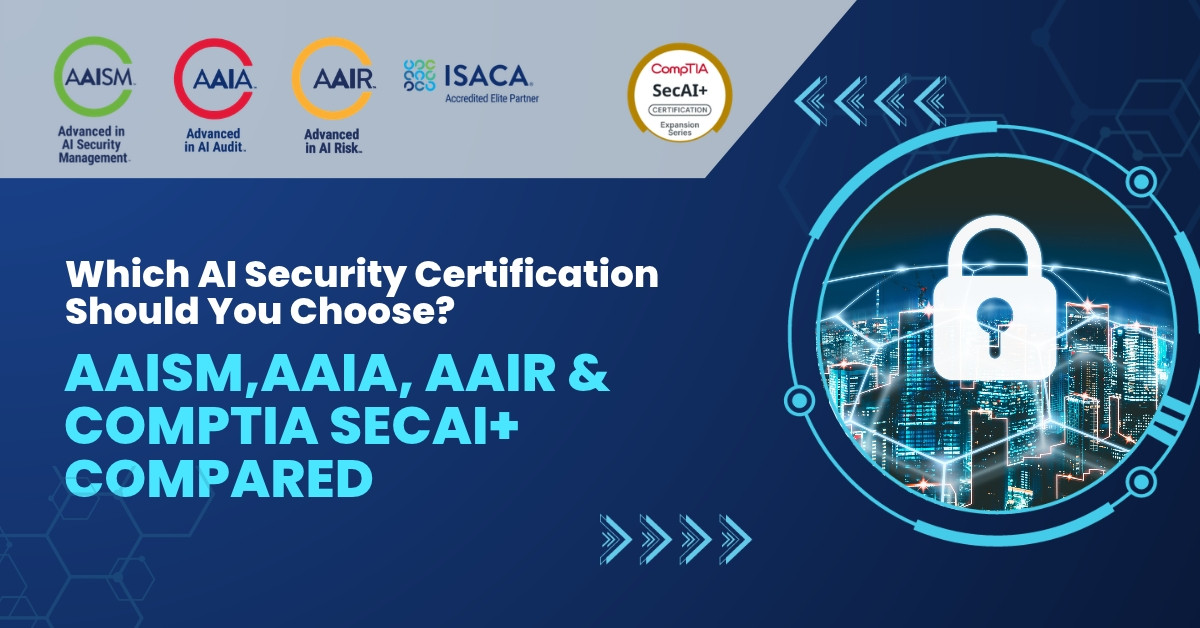
Which AI Security Certification Should You Choose? AAISM, AAIA, AAIR and CompTIA SecAI+ Compared
If you work in IT security, IT audit, risk management or compliance, you have probably seen artificial intelligence reshape the way organisations manage information and operational risk. As AI becomes part of customer service, financial analysis and business processes, professionals need to look beyond conventional cyber threats. Data protection, model risk, governance and regulatory responsibilities now form part of the discussion.
For those who already hold CISA, CISM, CISSP or CRISC, would an AI security certification be a worthwhile next step? More importantly, how do AAISM, AAIA, AAIR and CompTIA SecAI+ differ?
AAISM focuses on AI security management; AAIA on AI audit and assurance; AAIR on AI risk management; and CompTIA SecAI+ on the technical security of AI systems and their use in cybersecurity operations. The right route depends on your present responsibilities and where you want your career to develop.
Why AI Governance Matters as Hong Kong Organisations Adopt AI
AI is no longer an issue for technology teams alone. When organisations use AI in decisions and day-to-day operations, they must define who is responsible, how systems are controlled and what happens when an output is unreliable or an incident occurs.
In the banking sector, the Hong Kong Monetary Authority announced its ART Framework in October 2026. Its principles—Accountability, Resilience and Trust—underline the need to support AI innovation with clear oversight and operational safeguards.
For security, audit and risk practitioners, three related disciplines are particularly relevant.
AI Governance: Who Is Accountable for AI Systems?
AI governance concerns the policies, responsibilities, approvals and ongoing oversight that guide how an organisation develops, purchases and operates AI systems.
Consider a financial institution using AI to analyse customer information. Beyond checking the model’s accuracy, the organisation needs to establish who can approve its deployment, who monitors unexpected results and how concerns are escalated. Such decisions involve security, risk and audit functions as well as IT.
AI Compliance: How Can Organisations Meet Their Obligations?
AI compliance addresses whether AI use is consistent with applicable laws, regulatory expectations, industry requirements and internal policies.
For instance, before introducing an external AI service, a company may need to review how the supplier handles sensitive information, what access controls are in place and how changes to the model will be managed. Professionals in governance, risk and compliance (GRC) can build on established approaches while learning to evaluate risks that are specific to AI.
AI Privacy Protection: What Happens to Personal Data?
AI privacy protection is about protecting personal data throughout its collection, use, processing and storage in AI-enabled workflows. An employee pasting a customer document into a generative AI tool, for example, creates questions about permitted data use, access restrictions and the possibility of disclosure.
The Office of the Privacy Commissioner for Personal Data has published the Artificial Intelligence: Model Personal Data Protection Framework, which offers guidance on AI strategy, governance, risk assessment, human oversight and implementation. This reinforces why AI security also involves privacy and organisational accountability—not just cyberattack prevention.
What AI Skills Are Employers Looking For?
Recent recruitment activity points to growing attention to data and AI governance, technology risk and controls within established professional functions.
In October 2026, the Securities and Futures Commission advertised a Senior Manager (Data & AI Governance) role covering governance frameworks, policies, controls, AI risk and cooperation with information security, legal, risk and internal audit teams. The posting identified experience in data governance, technology risk or compliance as relevant, and qualifications such as CISA or CRISC as an advantage.
The example illustrates how an AI-related role can build on traditional assurance and risk expertise rather than requiring the candidate to be an AI model developer. However, a new certificate does not substitute for experience, nor should it be treated as a guaranteed route to a job or higher salary.
AAISM vs AAIA vs AAIR vs CompTIA SecAI+: Key Differences
When comparing certifications, look first at the professional responsibility each one is designed to support. Similar names do not mean identical skills or exam requirements.
| Certification | Primary focus | Best suited to |
| AAISM – Advanced in AI Security Management | AI security programmes, policy and controls | CISM or CISSP holders; security management professionals |
| AAIA – Advanced in AI Audit | AI audit, controls and assurance | CISA holders and other qualifying audit professionals |
| AAIR – Advanced in AI Risk | AI risk assessment, treatment and oversight | CRISC holders and other eligible risk practitioners |
| CompTIA SecAI+ | Technical AI system security and cyber operations | Security analysts, SOC analysts, security engineers and DevSecOps professionals |
AAISM: For Professionals Responsible for AI Security Management
ISACA’s Advanced in AI Security Management (AAISM) builds on existing security management expertise. It is intended for professionals who must advise stakeholders, shape security policy, assess AI risks and oversee appropriate safeguards.
The AAISM examination covers three domains:
- AI Governance and Program Management (31%)
- AI Risk Management (31%)
- AI Technologies and Controls (38%)
Its scope includes AI-related security strategy, data lifecycle considerations, supply-chain risks, security architecture and monitoring. If you already hold CISM or CISSP and are moving into AI security oversight, AAISM is a relevant option.
Eligibility: ISACA requires candidates to hold an active CISM or CISSP credential and satisfy its examination and certification requirements.
KORNERSTONE’s AAISM training is structured around the official domains and helps experienced practitioners connect AI security controls with enterprise management decisions.
AAIA: For Auditors Extending Their Expertise to AI Systems
ISACA’s Advanced in AI Audit (AAIA) focuses on evaluating how AI systems are governed, designed, operated and controlled. Auditors may need to review data sources, model monitoring, responsibilities, testing arrangements and the evidence supporting management’s assurance claims.
The examination covers:
- AI Governance and Risk (33%)
- AI Operations (46%)
- AI Auditing Tools and Techniques (21%)
For a CISA holder whose responsibilities increasingly include AI-enabled processes, AAIA offers a way to develop more specialised assurance knowledge without abandoning existing audit expertise.
Eligibility: ISACA accepts CISA, or certain other qualifying audit or accounting designations where the specified IT audit or advisory experience criteria are met.
KORNERSTONE’s AAIA course uses the three official domains to help audit professionals examine AI-related design, operations, risks and controls in a structured way.
AAIR: For Professionals Managing Enterprise AI Risk
ISACA’s Advanced in AI Risk (AAIR) extends established risk management practice to the lifecycle of AI systems. This includes identifying risk scenarios, assessing model-related exposures, selecting responses and monitoring third-party dependencies.
Its domains are:
- AI Risk Governance and Framework Integration (37%)
- AI Life Cycle Risk Management (21%)
- AI Risk Program Management (42%)
AAIR is particularly relevant for professionals in enterprise risk, technology risk, GRC or IT risk who need to incorporate AI into existing governance and reporting processes.
Eligibility: Candidates must hold one of ISACA’s accepted prerequisite certifications, such as CISA, CISM, CRISC, CGEIT or CDPSE, or an accepted non-ISACA designation, and meet the additional certification requirements.
KORNERSTONE was the first provider to introduce AAIR training in Hong Kong, making this emerging field of professional development accessible locally. The training covers the official exam domains and uses practical scenarios to connect risk governance, lifecycle management and risk programmes with workplace responsibilities.
Its AAIR training programme helps participants examine how AI-related risks can be identified, assessed, addressed and monitored in organisational settings.
CompTIA SecAI+: For Hands-on AI Cybersecurity Skills
If your priority is securing AI systems, investigating threats or improving security operations, CompTIA SecAI+ may be a closer fit than a governance-focused credential.
For professionals comparing an AI cyber security certification with management-oriented options, SecAI+ places greater emphasis on applied technology. Its four exam areas include:
- Basic AI Concepts Related to Cybersecurity
- Securing AI Systems
- AI-assisted Security
- AI Governance, Risk and Compliance
A SOC analyst, for example, may need to understand how AI can assist with threat detection and incident response while recognising prompt injection, data poisoning and exposure of sensitive information as risks to the AI environment itself.
Recommended background: Approximately three to four years in IT, including at least two years of hands-on cybersecurity experience. CompTIA also recommends Security+, CySA+, PenTest+ or equivalent knowledge. These are recommended experience levels, not formal mandatory prerequisites.
KORNERSTONE’s CompTIA SecAI+ training addresses AI threat modelling, system security, access controls, AI-related threats and governance considerations with an applied cybersecurity perspective.
Already Hold CISA, CISM, CISSP or CRISC? How to Choose
Your present role is a useful starting point for selecting further study.
| Professional background | Credential to explore | Likely development focus |
| CISM / CISSP | AAISM | AI security management, enterprise policy and controls |
| CISA / qualifying audit professionals | AAIA | AI audit, control assessment and assurance |
| CRISC / qualifying risk professionals | AAIR | AI risk assessment, treatment and monitoring |
| Security+ / CySA+ / PenTest+ and technical roles | CompTIA SecAI+ | AI system security, threat detection and cyber operations |
This is a guide to professional fit, not a statement that every listed credential automatically satisfies another certification’s prerequisites. AAISM, AAIA and AAIR each have their own eligibility requirements. If your role spans several disciplines, begin with the gap most relevant to your current responsibilities.
Why Choose KORNERSTONE for AI Security Training?
A professional training decision should take account of more than an exam syllabus. The trainer’s industry background, ability to explain practical situations and familiarity with the relevant credential all matter.
KORNERSTONE offers training across AAISM, AAIA, AAIR and CompTIA SecAI+, covering AI security management, AI audit, AI risk and technical cybersecurity. This breadth helps professionals explore routes that fit their existing responsibilities, rather than treating every AI credential as interchangeable.
Trainers with Expertise Across AI and Established IT Disciplines
KORNERSTONE’s trainer team draws on experience in IT management, information security, audit, risk and corporate learning, alongside knowledge of the relevant certification requirements.
For example, AAISM trainer Henry Yeung has more than 20 years of IT management experience and has been delivering corporate training since 2018. His background includes AI security, governance and secure digital transformation for different organisational audiences.
The AAIA training programme is also led by an experienced cybersecurity practitioner, with expertise spanning cloud and network security, security operations and advisory work. Learners can therefore connect exam topics with the decisions and controls they encounter at work.
Official ISACA Accredited Training Partner
KORNERSTONE is listed as an Elite ISACA Accredited Training Partner. Its ISACA-aligned programmes use official training materials and follow the exam domains and weightings to support systematic preparation.
Scenario-based Learning with Practical Relevance
The courses combine certification content with workplace scenarios such as AI risk assessments, security controls, audit procedures and governance frameworks. KORNERSTONE also offers corporate in-house training options for organisations with particular team requirements.
AI Security Certification: Frequently Asked Questions
I already have CISA. Should I take AAIA or AAIR first?
If your day-to-day role focuses on IT audit, internal controls and assurance, AAIA is a closer fit. If you increasingly advise on enterprise risk, AI risk assessments or treatment decisions, AAIR is worth exploring. Check ISACA’s eligibility rules before registering.
Can I take AAISM without CISM or CISSP?
Under ISACA’s current requirements, AAISM candidates must hold an active CISM or CISSP credential. If you do not yet qualify, it may be more useful to strengthen your security management background first.
What is the difference between AI governance, security and risk?
Governance determines policies, accountability and oversight. Security protects AI systems and related data. Risk management identifies, assesses and treats potential exposures throughout the AI lifecycle. The functions overlap, but they call for different professional responsibilities.
Does completing a training course award the certification?
No. Training completion and professional certification are separate. Candidates must still meet the issuing body’s prerequisite, examination and application requirements.
Considering Your Next Step in AI Security?
AI adoption is creating new governance, audit, risk and security questions for established IT professionals. Choosing a qualification that complements your current experience can be more useful than selecting the newest certification by name alone.
KORNERSTONE offers training in AAISM, AAIA, AAIR and CompTIA SecAI+.
To discuss course content, eligibility, schedules or fees, please complete the Course Enquiry form below. The team can help you review the options against your professional background.
Enquire Now
Get in touch with our team via the form or WhatsApp »
Popular Articles